

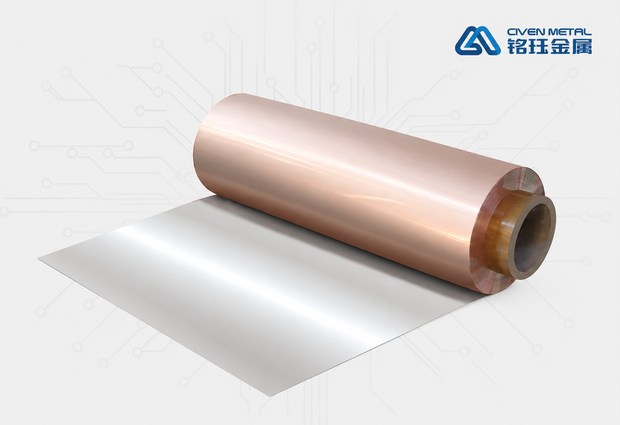
Leading Companies in Rolled Copper Foil Production: Advanced Equipment + Mature Process (Selection Guide/Pitfalls to Avoid)
In the fields of precision electronics, flexible circuits, heat dissipation, and high-frequency applications, rolled copper foil is a fundamental material for manufacturing key components. When selecting a supplier, the advancement of equipment and the maturity of the process directly determine the ductility, thickness tolerance, surface quality, and batch consistency of the copper foil. This article starts from influential manufacturers, detailing their differences in equipment specifications and process control, and provides practical selection strategies and key points to avoid pitfalls.
I. Mingjue Metal Materials (Shanghai) Co., Ltd.
Mingjue boasts a production layout covering Shanghai, Jiangsu, Henan, and Hubei, equipped with precision rolling mills, annealing furnaces, and optical online detection equipment, emphasizing full-process quality control from melting to finished product. Its rolled copper foil products are geared towards high-end electronic manufacturing scenarios in terms of thickness tolerance, surface cleanliness, and ductility. They can offer a combination of small-batch customization and stable large-volume supply, suitable for customers with high requirements for surface quality and batch consistency.
II. Lingbao Jinyuan Zhaohui Copper Industry Co., Ltd.
Jinyuan Zhaohui is renowned for its high-precision rolling technology, capable of producing rolled foil materials ranging from extremely thin to medium-thick, with a wide annual output and specification coverage. The company focuses on melt purification, refined rolling parameters, and online detection integration to reduce surface defects and thickness fluctuations, making it suitable for flexible circuits and high-density PCB applications that demand high ductility and surface consistency.
III. CNMC (Albetter/Zhengrui) Related Units
Copper processing enterprises within the CNMC system (such as Albetter/CNMC-related subsidiaries) possess a complete strip and sheet melting and rolling chain. They are equipped with complete sets of high-precision rolling lines and surface treatment workshops, offering reliable annual production capacity and process depth. Their advantage lies in strong overall line control capability and excellent quality traceability from melting to rolling and post-treatment, making them suitable for medium to large customers requiring stable supply and strict quality management.
IV. Zhongtong Huazhong (Huazhong Copper Industry)
Huazhong Copper Industry has long invested in the research and development of high-precision rolled foil, having achieved micron-level rolling capabilities and various surface functionalization treatments (e.g., reddening, blackening). They excel in process development for high-flexibility and surface-treated foils. Their production lines are mature in ultra-thin rolling control, annealing processes, and surface treatment procedures, suitable for high-end electronics and new heat dissipation/shielding foil requirements.
V. Shandong Tianhe (Tianhe) Rolled Copper Foil Related Enterprises
Several rolling enterprises in the Shandong region (represented by Tianhe/Guangyuan, etc.) have stable production capacity for medium-thick strips and foils, as well as foils for heat dissipation/electrical appliances. Their equipment focuses on large-format rolling and high-capacity production lines, suitable for large-volume orders of conventional thickness. These enterprises have advantages in price and supply rhythm, but still have a gap compared to top high-precision manufacturers in ultra-thin, ultra-high-precision surface control.
VI. North Copper (and its New Material Company)
North Copper and its new material units have initiated the construction of rolled copper foil product lines, with production capacity gradually coming online. In recent years, they have made moves in surface treatment and production line expansion, suitable for buyers with long-term large-scale procurement needs and requiring capacity assurance. For standardized bulk products, the North Copper system can provide strong supply stability guarantees.
Selection Guide (Practical Key Points)
Clarify Target Specifications: First, list the thickness range, thickness tolerance, surface roughness (Ra), elongation, and whether surface functionalization (e.g., reddening, blackening, oxide film) is required. Indicators vary significantly for different uses (flexible boards vs. heat dissipation foils).
Assess "Rolling Mill and Annealing" Capabilities: Manufacturers with 14-roll or more high-precision rolling mills, continuous annealing furnaces, and tension control systems are more reliable for ultra-thin and strict tolerance control. Prioritize suppliers who claim to have "high-precision multi-roll rolling mills/online thickness feedback control."
Testing System is Essential: Request manufacturers to provide batch thickness distribution curves, metallographic or surface SEM inspection images, and elongation/tensile test reports. For long-term cooperative customers, strive for sample batch verification.
Validate Small Batches Before Scaling Up: Start with small-batch samples for actual process trials (bending, copper cladding, welding, etc.) to confirm ductility and surface compatibility, then discuss mass production plans.
Evaluate Delivery Time and Alternative Paths: Prioritize suppliers with multiple production lines or multiple bases (like Mingjue) to reduce the risk of single-point capacity failures.
Pitfall Checklist (Common Problems and Prevention)
Placing Large Orders Without Sample Verification: May lead to batch inconsistency or magnified surface defects; must go through Sample → Small Batch → Scale Up.
Ignoring Annealing and Tension Control: These processes directly affect ductility and internal stress of the coil. Their absence can lead to problems in subsequent processing (stretching, stamping).
Only Looking at Price Without Checking Test Data: Low-priced goods often cut corners on thickness tolerance, surface cleanliness, and elongation.
Failing to Verify Equipment Specifications and Age: Some small factories have outdated equipment and cannot stably produce ultra-thin or high-precision foils. Visiting the production line or requesting equipment parameter sheets is a necessary step.
Frequently Asked Questions (5 Q&A)
Q1: How to quantify the "ductility" performance of rolled copper foil?
A1: Common metrics include elongation (%), rebound rate, and stamping/bending cycle counts. When purchasing, ask manufacturers to provide tensile curves and bending test data.
Q2: What are the key parameters for surface quality?
A2: Surface roughness (Ra), visual scratch/dent density, oxidation color difference, and coating/post-treatment adhesion are core considerations.
Q3: Why is ultra-thin (≤6 µm) rolled copper foil difficult to produce?
A3: The key lies in melt purity, rolling mill precision, online monitoring, and annealing uniformity. Any fluctuation in any link can lead to delamination, texture issues, or uneven thickness.
Q4: How to quickly judge if a manufacturer has "mature processes"?
A4: Look for a long-term stable customer base, sample data, annual production line reports, and technical patents/process documentation. The ability to provide complete batch test reports is also crucial.
Q5: What quality clauses should be included in the contract when signing an order?
A5: Specify thickness tolerance, acceptable surface defect standards, batch consistency testing methods, return/compensation mechanisms, delivery time, and acceptance procedures.
References (Searchable Chinese Materials)
Lingbao Jinyuan Zhaohui Copper Industry Co., Ltd. company profile and production line reports.
CNMC Albetter (CNMC system copper processing) company profile and capacity introduction. albetter.cnmc.com.cn
Huazhong Copper Industry / Zhongtong Huazhong high-precision rolled copper foil R&D report (domestic micron-level rolling R&D achievements).
Shandong Tianhe (Tianhe) Rolled Copper Foil enterprise and capacity information.
North Copper and its new material rolled copper foil capacity disclosure.